Showing posts with label Thailand Travel. Show all posts

Thursday, October 18, 2012

Overland Travel Bangkok, Thailand to Cambodia


Here’s the run-down on our overland journey from Bangkok, Thailand to Battambang, Cambodia. It should be useful for those traveling to other areas of Cambodia as well (like Siem Reap or Phnom Penh). 

There are several options for traveling from Bangkok to Cambodia. One is to buy a bus ticket to Poipet, at the border between Thailand and Cambodia. This should cost somewhere around 160 baht, but whatever you do, don’t book a ticket at one of the tourist offices on Kaoh San Road!! Never, ever book tickets on Kaoh San Road. Instead, ask a tuk-tuk driver to take you to one of the government-run tourist information offices and book your ticket there. You’ll get much better deals here on travel all throughout Thailand at these offices because the travel agents don’t make commission. A second option is to take a taxi, which is fast, but will cost an outrageous amount of money.

The other option is much longer, but it’s more affordable and more fun. Trains leave from Hualamphong Train Station in Bangkok for Aranyaprathet (near the border) every day at 5:55 am. Tickets are third class and cost only 48 baht. Get there a little bit early to ensure you have a seat. The train is pretty full toward the beginning of the journey with kids heading to school, but it should thin out after an hour or so. The train ride is about 6 hours long and there are plenty of opportunities to buy food or drinks from women patrolling the aisles between stops.

When you get to Aranyaprathet, you’ll be rushed by tuk-tuk drivers to drive you to the border. Don’t pay anymore than 60 baht! Many drivers will also want to drop you off just shy of the border at an office, where they will offer to take care of your visa. Don’t get your visa here! There are often extra fees (not to say you won’t run into that at the border as well, but more on that later). Just make the short walk to the border, where you’ll probably be directed by an official.

Getting your visa:

Cambodia allows visas on arrival, but you will need to make a few preparations. First, have a passport-sized photo of yourself available for the visa application. Secondly, come prepared with exact change for the fee, preferably in U.S. Dollars (USD is accepted all over Cambodia along with riel!). The visa fee should be no more than $20. However, there are infinite stories of people getting slapped with mystery fees that likely go right into someone’s back pocket. When we applied for our visas there was a hand-written sign on the counter advertising a fee of “700 baht+100 baht,” or about $26 total. The 100 baht fee was a mystery, but after some questioning we were told it was a visa-on-arrival fee. When we questioned further we were told that if we had USD we could just pay $20 plus the 100 baht fee, which would have saved us money. Alas, we had no USD, but we got out of it by showing them 700 baht and saying it was all we had. Finally, they caved. Moral of the story: have a $20 bill and a little baht on you and don’t budge, and you’ll only get a tiny bit ripped off.

Travel beyond the border (and some good news!):

In the past, the transit situation at the border of Cambodia has been nothing short of a mess. Before we arrived we found it difficult to find any sort of clear information on how to get from the border to Battambang. Some sites said there were buses, but only early in the morning. Others said we would have to pay close to $50 for a shared taxi. When we arrived, we found out the government had recently made some changes to make things easier for tourists arriving overland. Here’s the situation as of now (2012): there is a very handy (and free!) shuttle bus from the border to the bus station, where buses and taxis leave regularly for most major destinations. The ticket prices are a little high, but there’s not much of a choice at this point (and it beats paying for a taxi if you’re traveling solo or in a pair). A few tips: have enough U.S. money or baht on you to pay for your ticket (baht is accepted in some parts of Cambodia near the border). You can exchange money for riel at the station, but the exchange rate is terrible and there are no ATMs around. They also don’t accept credit cards. If you have USD, make sure it doesn’t have any rips or tears, or it won’t be accepted.

Here are some prices:
Poipet->Battambang: $10 bus, $45-$50 taxi
Poipet->Siem Reap: $9 bus, $45-$50 taxi
Poipet->Phnom Penh: $15 bus, >$50 taxi
Poipet->Sisophan: $5 bus

Expect bus prices to be more reasonable once you’ve gotten beyond the border (i.e. a ticket from Battambang to Siem Reap is $4).

The budget journey from BKK to Cambodia overland is a long one, but it is worth it! Just keep an eye out for scams and come armed with exact change, and it will be relatively smooth. Happy traveling!

Sunday, October 14, 2012

Ayutthaya: A Glimpse into Ancient Thailand


Thailand is a country rich in many things. From the endless supply of good food, to the wonderful people, to the stunning ecological diversity, it seems one could never run out of treasures to discover in The Land of the Smile. But a trip to Thailand is incomplete without exploring it’s vibrant culture and fascinating history, and there is no better place to start than the ancient capital city of Ayutthaya.

Now for those of you who are confused, yes, Bangkok is the capital of Thailand. But it hasn’t always been. Ayutthaya was the second capital of Thailand, from 1350 to 1767, when it was destroyed by the Burmese. In the tragic razing of the city all of its inhabitants were forced to flee, leaving Ayutthaya desolate, a shell of its former splendor. Today the city of Ayutthaya sits among the ancient capital’s ruins, creating an incongruous yet appealing concurrence of ancient and modern. Visitors to the charming city, strolling the sidewalks or cycling along the busy streets, will suddenly chance upon the large, looming towers and pretty stupas of an ancient temple complex, their bricks discolored from years of sun and neglect. A venture inside any one of these sites reveals clues to the life and devotion of the city’s former inhabitants. Buddha images, most of them broken and blackened from smoke, lie around every corner, many of them newly decorated with flowers, offerings, or sashes. Whether you’re interested in these small treasures or in the stunning architecture of the sites themselves, Ayutthaya’s ruins will not disappoint.

Getting there:

We arrived in Ayutthaya via train from Bangkok. Trains leave regularly for Ayutthaya from Hualamphong Railway Station, and third class tickets cost only 15 baht for the 2 1/2 hour journey. The city of Ayutthaya is actually situated on an island at the convergence of three rivers, so you will need to cross the river upon arrival. A ferry onto the island is only 4 baht; upon exiting the train station simply walk across the street and continue straight down a small road to the river (a 5 minute walk) to catch the ferry. Some of the tuk-tuk drivers on the other side of the river are only interested in giving tours of the ruins, so you may end up walking to your hotel from the ferry port, but the city is very walkable. Otherwise, you can get a taxi at the train station to take you directly to your hotel.

We stayed at Ayutthaya Place Youth Hostel, which I highly recommend! For a steal of a price we got hot water, soft beds, toilet paper (lets all take a moment and thank God for toilet paper), free wifi, and a small breakfast. The staff is also super friendly and helpful. The only downside is there’s not much in the way of food within walking distance unless a night market is set up close (this changes day to day), so plan accordingly. If a night market is close when you go, don’t miss it! Of all the markets we’ve been to so far, Ayutthaya’s had the most wonderfully dizzying selection!

Most hotels will give you a tourist map when you arrive. The map is easy to follow and conveniently numbered, and many locals seem to be familiar with it. This was helpful for me, as I was tragically born without a sense of direction and Kim fell ill our first day, so a bit of my exploring was done solo. In most cases I would be lost without Kim, in both the literal and figurative senses. But thankfully the city is easy to navigate, which is perfect for travelers on a budget! We did all our exploring on foot and still saw many of the important sights in well under two days.

Itinerary:

What you’ll be able to see in Ayutthaya all depends on how much time you have. Many people just do a day tour from Bangkok without staying the night. I wouldn’t recommend this simply because it’s not worth the cost. You can see more on your own than on a tour and spend a lot less money doing it! Two to three full days will be plenty of time to see everything, but if you have less time or want a more leisurely trip, you can still see the biggies. We relaxed on the afternoon of our arrival and dedicated half the following day and the morning of our last day to sight-seeing (about one full day total) and were happy with what we saw.

It’s difficult to know where to start in Ayutthaya if you’re only going off a list of the ruins—there’s a bunch! The man at our hotel was kind enough to tell us which ruins he thought were the most important to see. This, along with cost, helped us decide what to visit. Some of the temples charge 50 baht per entrance; some are free. There is also a day pass you can buy for 220 baht from the museum or one of the ruins, but it only includes admission into 6 ruins, all of which are regularly 50 baht. This pass is worth it if you plan on visiting all six. However, two of the ruins are off the island, so what you save in admission fees you’ll make up for in transportation costs (either a tuk-tuk or bicycle rental; more on that later). We chose the free option and walked easily to seven sites. Total cost: 200 baht for 1 person.

Below is our itinerary. The two clusters are temples that are all near each other. Those in bold are the ones our local friend recommended we see. Those with a * are part of the day pass deal, which is listed afterward. Admission fees are included in (parentheses).

Day 1:
Wat Phra Ram* (50 baht)
Wat Phra Si Sanphet* (50 baht)
Wihan Phra Mongkhon Bophit (free)
Wat Lokayasutharam (free)

Day 2:
Wat Maha That* (50 baht)
Wat Ratchaburana* (50 baht)
=200 baht

Day Pass (220 baht) includes:
Wat Phra Ram
Wat Phra Si Sanphet
Wat Maha That
Wat Ratchaburana
Wat Chaiwatthanaram (off island)
Wat Mahayong (off island)

Like I said, we saw all our ruins on foot. If you have the time and the energy, it’s a great way to do it! Put on some good walking shoes, stop off at one of the fruit stands and grab a snack, and see the city at your leisure! On a really random note that I’m sure some of you will appreciate knowing, I kept on running into those crazy floating spider web things while I was walking. Although they will definitely give you the heebie-jeebies, from what I could tell there were no spiders on me after being ambushed by the aforementioned fiends. So don’t totally freak out, like I kind of did. 

If you want to pack more sights into a shorter amount of time, you can either rent a bicycle for around 40 baht per day, or hire a tuk-tuk driver to take you around to all the sites. We didn’t get a quote on a tuk-tuk driver, but I would expect to pay anywhere from $10-15 for a day.

Here’s a more detailed run-down of what we saw:

Wat Phra Ram: Constructed on the cremation site of King Ramathibodi I (1351-1369) sometime after his death, this site is now next to a large busy street and seems to come out of nowhere. Even more out of place are the elephants strolling down the adjacent street, tourists perched on their backs to tour the outside of the ruins. Inside the complex you’ll find dozens of buddha images scattered along walls and among foundations, all of them partially destroyed by the Burmese. You’ll see many attempts at reconstruction, with rocks perched atop torsos as makeshift heads and broken arms placed gently back into their positions. This wasn’t one of the must-sees indicated by our helpful friend, but it’s really beautiful and definitely worth a look. I recommend seeing it before Si Sanphet, as it’s on the way, and Si Sanphet is a bit more impressive; you’ll want to build up rather than down.
Buddha image at Wat Phra Ram

Wat Phra Si Sanphet: This compound, built during the 15th century, is stunning in its diversity. The typical brick stupas abound alongside the scattered remains of walls and archways, as well as a neat rectangular structure with tall pillars and lots of buddha statues. But the most stunning part of the compound is the magnificent row of white stone stupas. With these stupas set against the brick ruins, green grass, and bright blue sky, the contrast in this compound is simply breathtaking. Take your time here, and notice the various decorations and offerings placed in front of many of the buddha images. Simple touches like this add to the beauty of this Wat!

White stones stupas at Wat Phra Si Sanphet
Wihan Phra Mongkhon Bophit: This is a modern temple that is still in use today situated right next to Wat Phra Si Sanphet. It’s a typical Buddhist temple, very ornate, and houses one of Thailand’s largest bronze buddhas. The statue is 12.5 meters high without the base and 9.5 meters across at its widest point. This is a quick stop, but well worth it since it’s so close and admission is free!

Wat Lokayasutharam: This wat is also known as Reclining Buddha, for obvious reasons. The statue is an impressive 37 meters in length and is built from brick. I read a few reviews of this place before visiting, and a few people advised travelers that it wasn’t worth the visit, since the buddha is “all there really is to see.” I say, Psha! While there’s not much else at this site besides an old foundation and a simple prang, the statue itself is well worth the visit for several reasons. First, it’s gorgeous. Second, it’s a 5-10 minute walk from Wat Phra Si Sanphet/Mongkhon Bophit. Third, it’s free. Need I say more? Well ok, it’s also a prime spot for photo opportunities. “Hey, here’s me next to Buddha’s foot! Look how small I am!” Go in the afternoon, when the sun is best for photo taking.
Tiny Me by Wat Lokayasutharam (aka Reclining Buddha)

Wat Maha That: You’ll see many of the typical sights here—stupas, prangs, etc. But the most impressive part of this wat is the famous “Buddha Tree.” In a dramatic display of Mother Nature’s stubborn, delicate beauty, one of the buddha heads lopped off by the Burmese in their destruction of the temple has since become entwined in the roots of a nearby tree, creating what is one of Thailand’s most recognizable images. No one is sure exactly how it happened, but it is stunning, and reminiscent of many of the Angkor ruins in Cambodia.* 
The Buddha Tree at Wat Maha That

Wat Ratchaburana: Our last site visit didn’t disappoint! Wat Ratchaburana is laid out in an easy-to-explore manner with gorgeous stupas, a large courtyard, and other smaller ruins surrounding a central structure. You can walk up the stairs and into an open tower, which was once a crypt and held many bronze images, golden objects, and jewelry that are now housed in the Chao Sam Phraya Museum. Inside the tower there is a small, creepy set of stairs you can go down that lead to a few unrestored rooms whose walls are covered in paintings. Very Indiana Jones. Here, just as at the other sites, there were also numerous buddha images scattered around, many somewhat put back together, and all very pretty.
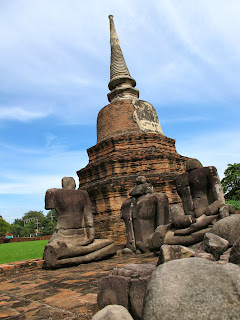
Buddha images and a stupa at Wat Ratchaburana
-----------------------------------

My advice: don’t spend all your time in Bangkok and miss out on the splendor of Ayutthaya. With transportation from Bangkok costing so little, there’s almost no excuse not to go, and you won’t regret spending a little time in this charming city! Happy exploring!


*For those of you planning to visit Cambodia during your travels, we recommending seeing Ayutthaya before visiting Angkor Wat. Normal temple ruins simply aren’t as impressive after seeing mother Angkor!
For more information on the history of Ayutthaya: www.ayutthayahistory.com

Monday, October 8, 2012

Bangkok: A City of Endless Possibilities


The city of Bangkok needs very little introduction. It is a city known worldwide and is a favorite tourist destination in Asia for its big-city feel, captivating culture, incredible food, and friendly locals. It is also home to one of the largest and most traveled through airports in Asia, making it a convenient stop on the way to other nearby destinations. Sarah and I stayed in Bangkok for a total of 5 days and could have easily spent more time there.

Where to Stay

For our first 4 nights in Bangkok, we stayed at Sinad Guesthouse located a short walk from the famous Koh San Road and other popular destinations in the city. It was about 750 baht each for the 4 nights there (approximately $24.50), and it served as a nice home base to go from. 

We unexpectedly had to stay in Bangkok a fifth night after our trip to Ayutthaya (we missed our train, but that’s another story in itself). We decided to stay at a cheap hostel on Koh San Road because of the convenient location. Unfortunately, we soon discovered the reason some people advise travelers not to stay on Koh San Road during their time in Bangkok. Literally a minute or two after we laid down to go to sleep, loud (and I mean LOUD) music began blaring from one of the bar/clubs next door. This didn’t stop until around 5:30am, at which point we were already leaving to catch our train to Cambodia. Needless to say, I pretty much didn’t sleep that night and grumpily regretted staying where we did (but hey, it’s a learning experience). So unless you want to spend your nights out partying (and if you do, then by all means stay on Koh San Road), avoid accommodation here at all costs! You’ve been warned. 

Activities in the City

Bangkok is full of endless sights to see and things to do. Here are a few of the highlights from our time there:

Wat Saket (The Golden Mountain) is a Buddhist temple in Bangkok. “The Golden Mountain” is a huge hill inside of Wat Saket with a large staircase leading to the top. There is no cost to climb the hill, and at the top you can enjoy breathtaking panoramic views of Bangkok in all directions. It’s well worth the walk up simply for this reason. 
View from The Golden Mountain
Wat Arun (Temple of Dawn) is located on the west bank of the Chao Phraya River and legend says that this is the temple King Taksin arrived at (as dawn was breaking) after escaping the Burmese army when they advanced upon the city of Ayutthaya. It costs 3 baht to cross the river on the local ferry and visit the temple, which costs another 50 baht (approximately $1.65) to enter. It is well worth the small fee as the structure itself is absolutely beautiful. If you are in good shape and manage to climb your way up the incredibly steep staircases, the top of the temple also affords stunning views of the river and other nearby areas. Definitely worth a visit!

Temple of Dawn
The Grand Palace is one of the most famous places among tourists to visit in Bangkok. This well known landmark was once home to the Thai King and is admired for its dazzling architecture both inside and outside the palace. It costs 400 baht to enter it (approximately $12.75), and Sarah and I decided not to explore the insides of the palace mainly for this reason. We walked around the outside though, and if money is not really an issue for you it might be worth checking out!

Chinatown is a fun place to visit and admire all the interesting foods and fun stalls in the area. It is best to go here during dinnertime, at which point Chinatown is at its liveliest. We went there for dinner one night and both ordered a tasty-looking noodle soup we saw some others eating at a food stall. About halfway through the bowl, I realized that what I had thought was pork was actually the organs of some unidentified animal. Yum! Well, it makes for a great story anyhow.

Dinner in Chinatown!
The MBK Shopping Center is a huge multi-level shopping mall that is vastly popular among tourists and locals alike. Shops and stalls on the 8 different floors sell clothing, shoes, food, electronics, furniture, DVDs, souvenirs, and much more. There are over 2,000 shops in this mall and it is unlikely you will be unable to find what you are looking for. Another huge plus is that the building is air conditioned, which is a big deal if you are in Thailand during the warmer times of  the year. Be ready to bargain at a lot of these shops - many good deals can be found here! My favorite purchases of the day from this shopping mall were a 6-inch Subway sandwich for 49 baht (about $1.65) and a large chocolate dipped ice cream cone covered in colorful sprinkles from Dairy Queen for 20 baht (about 65 cents). So great!

MBK Shopping Center
Chatuchak Market is the largest market in Thailand and contains more than 5,000 stalls, covering approximately 35 acres. It takes place every weekend, and any tuk-tuk driver can take you there if you ask them. You can find everything from clothing to food to souvenirs and more. My favorite part of the market was the HUGE pet section. Seriously, we got lost in it because it was so vast. There was every type of pet you could possibly imagine being sold there: puppies, kittens, rabbits, large bugs, snakes, monkeys, black-tip sharks, squirrels, and many more things. I found an adorable black pug puppy for only $200 and seriously considered buying it and bringing it home with me. But really. 

Although Koh San Road isn’t the greatest place to stay in Bangkok, that doesn’t mean it should be completely overlooked! It is known as the “touristy” part of Bangkok, but you can find a lot of great souvenirs and food there for really cheap prices. And if you are into the hipster scene, there are an endless number of stalls selling cheap hipster tank tops and t-shirts (don’t ask why). Most of the food stalls on Koh San Road sell pad thai, springs rolls, fried rice, sticky rice with mango, and other popular Thai dishes that are popular in Western countries. Here’s a tip though: if you order food from one of these food stalls, make sure it is piping hot when you get it and is cooked right in front of you. I got sick on one of our last days in Bangkok from some spring rolls I ate on Koh San Road. They weren’t warm when I got them (other ones I had eaten during previous days had been hot when I ate them and didn’t give me any stomach problems), and I later got sick from them. They had probably just been sitting in the cart for too long and had gone bad. But if you’re careful, I would definitely recommend eating at these food stalls if you’re looking for a cheap bite to eat!

Koh San Road
One Final Tip

Many of the tuk-tuk drivers in Bangkok have an agreement with certain travel agencies and tailor shops where they get commission or free petrol if they bring tourists there. Many will offer to take you to a couple of temples for a really low price and then spring the tailor shop/ travel agency idea on you during the ride. So if you get offered a ridiculously cheap fare from a tuk-tuk driver, be a bit suspicious. One tuk-tuk driver made this offer while we stopped on the sidewalk to look at a map which was hanging on the trunk of a tree, but we firmly told him we were not interested (despite his numerous attempts to convince us we were missing out on a great offer). After our final refusal, he angrily ripped the map Sarah and I were looking at off the tree and stormed away with it (you know, like a five year old would). But don’t worry, the vast majority of the people in Thailand are incredibly helpful and friendly! And again, it just makes for another great story.

Sunday, September 30, 2012

Koh Phangan's [In]famous Full Moon Party


Imagine you’re at this fantastic party. Not only does it have all the basic elements of a good party—good music, good drinks, good food—but it is one of those rare social gatherings that’s full of just as many good people as it is cold beers. A new friendship is just as likely to form as a case of alcohol poisoning, and hugs and laughter are being shared along ill-chosen words. With three DJs to choose from and enough good company to keep you busy for days, time flies, and no one seems too concerned about going home. Now look to your right, and instead of seeing a secondhand couch filled with college students, you’ll see a pristine beach, the perfect circle of the full moon reflecting brightly on the water.

This is Koh Phangan, Thailand’s famous Full Moon Party, an all-night party event that signifies for it’s goers not only a good time, but a spiritual experience. Young and old (but mostly young) come from all over to attend this party, which is actually the climax of numerous pre-parties and after-parties in the days leading up to and after the full moon every month. Around full moon time, the entire southern part of this small island becomes a party-goer’s paradise. Tourists literally flood the island, booking all the boats, ferries, and hotel rooms, leaving some to sleep on the beach during high season. One only has to walk a short distance on the main road to see the signs advertising any excuse at all for a party: Half Moon Party, Silver Moon Party, Floating Bar Party, Jungle Party, Waterfall Party, etc. In short, if you’re looking to blow off some steam, look no further than Koh Phangan.

Getting There

Kim and I headed to Koh Phangan after our time in Phang Nga Town. A bus from Phang Nga to Suratthani leaves every morning and cost 150 baht. In Suratthani, ferry tickets or fast boat tickets to Koh Samui and Koh Phangan can be bought right off the bus from ticket agents who will most likely approach you as soon as you arrive (unless you book ahead). Kim and I bargained a little bit and got two fast boat tickets to Koh Phangan for 850 baht (425 each), including bus transfer from Suratthani to the pier. The journey took about 1.5 hours and we arrived on the island in the late afternoon.

When you get to the island you’ll be bombarded by about 7,000 taxi and motorbike drivers to take you to your hotel. The going rate is usually 100 baht, depending on where you’re going. Haad Rin (where the party takes place) and Baan Kai (a few kilometers West of Haad Rin, where we stayed) are both 100 baht per person for a shared taxi/van.

The beach in front of our hotel in Baan Kai

Like I said, we stayed in Baan Kai. This wasn’t exactly by choice; we forgot to book a room until a few days before the party. By then it was slim pickings. It all worked out fine and we enjoyed our stay at Green Peace Bungalows, which is right on the beach. But if you want our advice, book your room early!! And if you’re there for the party, Haad Rin is the place to be. Baan Kai isn’t too far from Haad Rin, but it is barely walkable. We’re hardcore, so we walked the distance to get to the Full Moon Party, but we made that decision before we knew how many hills there were. Plan wisely.

The island itself is beautiful and deserves a few days of your time, either for some extra exploring, or to rest up before/after the Full Moon Party. My favorite part was the beach by our hotel, which was filled with thousands of tiny little snails, all different colors and patterns, like they had been hand-painted! There was also a cool little sandbar we could walk right out to in order to get a great view of the island.

The Party

The Full Moon Party takes place on the Southeastern part of the island in Haad Rin. The party gets started after sundown, but the area is filled with shops, restaurants, and bars that play American movies and Family Guy on repeat. We showed up in the afternoon to get some food and hang out on the beach before it got too crowded. Make sure you arrive before 7, or you may get asked to pay 100 baht to enter the party.

Haad Rin, pre-party

Kim and I sat on the relatively small beach at Haad Rin while the sun went down, waiting to see party-goers fill the area. Before sunset vendors started setting up “bucket stands,” all decorated with unique (and sometimes inappropriate) names to attract tourists. A plastic bucket that includes ice, a bottle of liquor, and 1-2 mixers sells for around $5. Almost the entire beach was lined with bucket stands, encouraging playful gimmicks and cheap prices to stay ahead of the competition. Alcohol isn’t all you’ll see for sale on the beach. Food vendors selling barbecued meat, corn, and sweets also set up on the far ends of the island, and body painting stations ensure that the bright green and orange Full Moon Party t-shirts scattered throughout the crowd aren’t the only neon around.

Around 7:30 I began wondering if this thing wasn’t all it’s cracked up to be. The trickle was slow at first, so Kim and I wandered toward some of the many fire-throwers performing on the beach, and before long I was hypnotized. When I finally looked up, the beach had all of the sudden filled with people. I was amazed that so many people could fit on one little beach—and it wasn’t even high season! Kim and I floated in and out of three dance floors that had spontaneously formed, observing what seemed to be every possible type of person, from frat boys with blue clown wigs to parents with their children (which is a personal choice I won’t get into). No matter who it was, they were there simply to have a good time. There was one guy I just couldn’t get over, who danced with everyone in the crowd without ever straying from the same dance move, and was so good-natured about it I could have hugged him (but I didn’t). We ended up on the edge of the crowd, where we met a great group of people from Spain and the United States, with whom we instantly became friends and spent the rest of our night. Easy peasy.

Unfortunately, a lot of our pictures of the Full Moon Party were deleted in a tragic “Will-you-take-a-picture-of-us-in-front-of-this-cool-thing?” incident, so we only have a few snippets to show you. But the memories I have from this relatively short event are so unique I’m sure I will not soon forget them!

A few tips:

Leave your valuables locked in your hotel room, and keep what money you bring close to you (no off-the-shoulder bags). Pickpocketers abound in Haad Rin!

Watch your drink! Ruffies are no laughing matter, y’all.

Be cautious around the fire-throwers the later the night gets. Thousands of drunk people+fire+darkness=potentially really bad memories.

Get to the beach just before sundown to watch the crowds pour in and avoid unnecessary entrance fees.

Stick to the buddy system.

Be cautious, but also have fun! The Full Moon Party is a place to let go of inhibitions. Go with the flow, and come with an open mind!


For a list of Full Moon Party Dates click here.

Friday, September 28, 2012

Phang Nga Town: A Worthwhile Stop

Phang Nga is a province in southern Thailand, just north of the Phuket province. I fell instantaneously in love with it when I glimpsed breathtaking views of clouds of mist rolling over the deep green mountains on our first day there. It is the city where what Sarah and I now refer to as “the two perfect days” in Thailand occurred. So if you have had a rough time in Thailand or during other parts of your Southeast Asia travels thus far, Phang Nga may be a great stop to add to your travels!


Mist rolling over the mountains in Phang Nga town.
Arrival in Phang Nga

After our disappointing and failed attempt to tour the famous Phang Nga Bay via Ao Por Pier in Phuket (see our Phuket post to read that sob story), we decided to try a different approach to seeing the bay (which I was now 100% dedicated to seeing after spending so much time attempting and failing to do so). We decided to take a bus to the city of Phang Nga from the bus station in Phuket. We easily got our tickets for 90 baht each (about $3.00) and the bus conveniently left about 15 minutes after we arrived. The bus ride took about two and a half hours and dropped us off at the bus station in Phang Nga. Soon after we stepped off the bus, a man from a tour agency approached us and asked if we needed directions. He gave us a small map of Phang Nga and circled a place called “Phang Nga Inn” and said he highly recommended staying there. After a little convincing, we took his advice (and an information pamphlet about tours his company gave of Phang Nga Bay) and walked a short 5 or 10 minutes to Phang Nga Inn. The cheapest room they had was 400 baht per night (a little under $13.00) and came with real blankets, bath towels, air conditioning, and even a shower curtain (all things which we now consider luxuries)! It was a very quaint little inn with friendly owners; we would definitely recommend it to anyone planning to stop in this city.

Our next order of business was to figure out which tour to book for Phang Nga Bay. The tour offered by Mr. Kean’s Tours (which we read about in the pamphlet given to us earlier by the helpful man at the bus stop) seemed like a good option. They offer a half day tour (3-4 hours) for 500 baht (roughly $16.50) and a full day tour (7-8 hours) for 800 baht (roughly $25.75). We decided to just do the half day tour, figuring that 3 or 4 hours in the bay would be plenty of time. 

The longtail boat we toured the bay in.
Night Markets

There are different night markets in Phang Nga depending on which day it is. All are located in essentially the same area, and anyone can direct you there if you ask. The first night we stayed in Phang Nga, we got a little lost while trying to find the night market for dinner. I walked up to a woman standing on the side of the street and asked her if she could direct us to the night market. She asked if we were planning to walk and said it was kind of far. She then generously said, “I’m just waiting for my husband to pick me up. If you wait with me we can give you a ride there!” Her English was very good and we found out she was an English teacher at a nearby Thai primary school. Her husband pulled up in a car a few minutes later and happily greeted us. We then spent the short car ride asking her to teach us how to pronounce various phrases in Thai (Thai is a tonal language with 5 different tones and hasn’t exactly been the easiest to learn). 

When we got to the night market, it was already bustling with people. There were all sorts of foods there, and trust me when I say you will have a very difficult time deciding what to have for dinner. We got large dinners on both nights for about 40 or 50 baht each (roughly $1.35-$1.65). Definitely be sure to check the night markets out while here!

If you do not get dessert at the night market and are craving something sweet (and cold), we’ve found the perfect place. It’s a little shop called “Ice Baby” located on the main street between the Phang Nga bus station and Phang Nga Inn. They serve a delicious concoction that I’m not sure how to describe other than saying it is some sort of mix between shave ice and ice cream. It comes in all different flavors (but Sarah and I both got Thai Iced Tea) and each size comes with a different number of free toppings (I got cookies and sprinkles on mine). Delicious!

Phang Nga Bay

Even with all our built up excitement and high expectations for Phang Nga Bay, it did not disappoint. A small bus picked us up from our hotel around 8:00am the next day and a friendly family of four from England greeted us inside. When we stopped at the tour company office, the same man we had spoken to earlier motioned for us to get off the bus and talk to him. He pulled us aside and told us that no one else had signed up for the half day tour so it would be cheaper for him if we just did the full day tour instead (and showed us some math that I won’t bore you with). He told us that he wouldn’t charge us any more for the full day tour as long as we didn’t tell the family from England what we paid (which we happily agreed to, obviously). He said we’d also get free bottles of water, fruit, and lunch (score). A great start to the day.

James Bond Island
The seven of us (the British family and boat captain included) set out in the bay on a large wooden longtail boat. The bay is beautiful from the moment you see it and only gets better. We rode through fascinating mangrove forests and saw an extensive number of huge limestone formations jutting out of the water. We stopped on one small island in the bay to get a clear view of the famous James Bond Island (which appeared in the old James Bond movie titled “The Man with the Golden Gun”). It looked like something pulled out of the Avatar movie and was like nothing I had ever seen before (I think you’ll understand why when you look at the pictures). We also stopped on another island and the boat captain gave us each an unusually large headlamp and pointed us in the direction of a wooden ladder that lead to a huge cave (after oddly instructing us to leave our shoes behind). The cave, called “Tham Keaw Cave,” was enormous and fun to explore. We then returned to the boat to eat our free lunch which consisted of fried rice with shrimp, bananas, and a couple bottles of water. Our next stop was an isolated little beach on a different island. It’s a pretty beach and we all went swimming (you also have the option to rent a canoe here for an hour or so if you choose). 

Exploring Tham Keaw Cave
Our last stop of the tour was supposed to be a colorful little fishing village built in the middle of the bay, but the boat engine broke down just before that. The captain spent about 15 minutes trying to fix it. At one point I glanced back at the engine and horrifyingly realized oil was literally POURING out of it directly into the ocean. A minute or two later, the captain grabbed a plastic bottle from a compartment in the boat with some sort of oil/liquid for the engine and poured it into the necessary place in the engine, at which point he haphazardly tossed the empty bottle into the ocean without a second thought! At this point, Sarah and I just started laughing (while cringing inside and planning future “Save the Environment” campaigns in Asia, of course). 

Phang Nga Bay fishing village
Eventually, another boat had to tow us over to the fishing village and we got out to look around while the captain worked on fixing the boat. If you choose to do the overnight tour through Mr. Kean's tour agency, this is where you will be staying (the British family chose to do this, so we parted ways here). After walking around the village a bit, where at one point a lady walked up and shoved a sloth/monkey creature (wearing a diaper, I should add) into my arms and asked if I wanted a picture for 40 baht (no.), we headed back towards the boat. When we got back to the dock, the boat still wasn’t fixed and we ended up waiting around for another hour until a different boat could take us back. The bus driver from earlier that morning was conveniently waiting for us when we arrived and took us back to the bus station in Phang Nga. A successful adventure! We would definitely recommend this tour to anyone else wanting to see the beautiful and enchanting Phang Nga Bay.

For more information on Phang Nga Town, click here.

Thursday, September 6, 2012

Getting the Royal Treatment in Phuket


Phuket, Thailand is best known for it’s stunning beaches, trips to Phi Phi island, snorkeling and diving, and the party central of Patong beach. It is Thailand’s biggest island, located at the southern tip of the country. The South and East coasts are lined with dozens of destination beaches while the Northern end of the island boasts beautiful waterfalls and Khao Phra Thaeo National Park. High season begins in November and the crowds mellow out by February, dropping to their lowest point during rainy season* (September-October). There are plenty of great blogs that will tell you all about Phuket’s beaches, since this is one of the main reasons many people visit (read a great run-down of Phuket’s beaches here). However, this will not be one of those blog posts, as we visited at the start of rainy season and instead spent much of our time in and around Phuket Town in the South/East part of the island. This post will be about getting the most out of modest, charming Phuket Town and the surrounding area.

Wat Chalong and Big Buddha

During our time in Phuket we Couchsurfed with a host about ten minutes outside Phuket town’s center. We arrived via plane and took the airport bus to Central Festival Mall (only 20 baht) and walked from there. Lucky for us, our house was only a few kilometers from Wat Chalong, the most visited Buddhist temple in Phuket. This ornate temple complex contains several beautiful and unique buildings and is decorated all throughout with elephant statues and elephant-shaped shrubs. Free admission makes a tuk-tuk ride to Wat Chalong doubly worth it, but hang on to your driver, because Phuket’s Big Buddha statue is situated on the hill above Wat Chalong, a six-kilometer drive if you want a close look at the statue and a 360 degree view of the island. It’s a good idea to work out a price with your driver ahead of time that includes both attractions.
One of the temples at Wat Chalong

Hittin’ the Town

Next we decided to explore Phuket town itself. Phuket town’s center is bustling and crowded even in low season, but there is something for everyone here. Coffee shops and bakeries are on every other corner and usually offer wifi if you want somewhere to relax and enjoy the A/C. Local eateries can be found just as easily with 30 baht noodles and chicken saté, or small markets carry enough colorful and mysterious desserts to keep you busy for days trying them all. There’s also plenty of souvenir shopping and some great used bookstores. If you want a dose of history the Phuket museum is located a few blocks from the fountain at the center of town, but there’s a small admission fee and the museum contains mainly old photographs and newspaper clippings. And finally for you Leonardo DiCaprio fans, the On-On Hotel is Phuket’s first hotel and is featured in Leo’s film The Beach. This seedy hotel is right in Phuket Town and has been providing rock-hard mattresses for weary backpackers to lay their heads since 1929.

Gettin’ Our Tourist on and a Note About Phang Nga Bay
 My very favorite day in Phuket started out as a total bust, and I’m going to tell you why. We had read online in some of those very lovely TripAdvisor travel forums that Phuket is a good jumping-off point to do a boat tour of the magnificent Phang Nga Bay. It was difficult to get clear information, but from what we could tell the place to go was Ao Por Pier in the Northeast part of the island, where we could get a boat for about 1200 baht (split between a group) for 3-4 hours. Please, don’t make our mistake and actually go to Ao Por Pier (or any pier near it) expecting a boat for 1200 baht. If you really really want to make the trip from Phuket, get there early and expect to pay at least 3000 baht for a short boat toar. But a way better idea is to get a bus to Phang Nga Town, where you can get a lovely half-day tour for 500 baht per person or a full-day tour for 800, and stay for a few days. It’s worth it. Trust us.

Well needless to say, we did go to Ao Por Pier, only to return several hours later with a couple of bad attitudes and no cheap, wonderful tour under our belts. But situations like this have a way of turning around, and when our driver dropped us off in the wrong part of Phuket Town, redemption showed up in the form of a very cheerful man with an SUV and a tourist map. 

Earlier we had had taxi drivers approach us with maps, offering to take us all around town and see the sights for just 100 baht each, but we turned them down. This man told us he’d take us all around and drop us off at our house for just 10 baht each. We were suspicious at first, but later found out the secret to these seemingly too-good-to-be-true offers. Many taxi and tuk-tuk drivers are offered a free liter of petrol for every tourist shop they take you to, whether you buy anything or not. So in order to get their petrol coupons they’ll throw in a few destinations like Big Buddha and the Butterfly Garden to get you interested and make 100 baht sound like a steal. We really just happened to luck out with our driver, who fessed up about the petrol and ended up giving us the entire ride for free in exchange for us meandering through a few (make that six) extra tourist shops. This might sound like a bummer, especially if you’ve taken a similar ride in Bangkok and have had to sit through more custom suit and tie shops than you ever wanted to see in your life, but we rolled with the punches and made the best of it. We went to gem and pearl shops to see jewelry-makers doing their thing and tried on lots of expensive jewelry that we would never buy. We stopped at overpriced markets and beauty stores where we tried every single free sample and tester without buying anything. And we saw a super cute baby elephant outside of a souvenir shop that ate grapes and did funny little tricks—all for free! I call that a good day.

Kim posing with our new elephant friend!

I know, I know, it was like, so touristy of us to do. But there’s no shame in being a tourist now and then, and even those seasoned backpackers who insist on calling themselves “travelers” and avoid the other t-word at all costs deserve to have a little cheap, shallow fun now and then. At any rate we made up for it at the end of the day when our driver (now very happy and drunk on petrol coupons) dropped us off the fabulous weekend market near Central Festival Mall. If you’re near Phuket Town on the weekend, don’t miss the weekend market! It opens in the afternoon and is a huge sprawling carnival of clothes, souvenirs, CDs, and most importantly, tons and tons of cheap, fabulous food. That and an ice cream run at the 7/11 near our host’s home afterward made for an absolutely redeemed day in Phuket, and a great end to our first two days in beautiful Thailand!


*Note: For those visiting Phuket during rainy season, use caution when swimming in the ocean! The currents during this time are notoriously deadly, and tourists have died swimming at the many beaches in Phuket with no regular lifeguard on duty. If you see red flags on the beach during any time of the year, please do not swim!